7/10/2026

The Hope of Salt Spring Island

Dock at Ganges, Salt Spring Island

I came back to Vancouver last Thursday to, amongst other things, watch the World Cup of soccer. Vancouver is one of the two Canadian cities hosting. Toronto is the other. I ran into a bunch of Swiss fans downtown at an Irish pub called The Shamrock, in for Switzerland versus Algeria. One of the Swiss wanted to know why nobody in Vancouver speaks French. I asked who they were going for, Switzerland or Algeria. 

The nationalistic chanting, flags and Canada-themed clothes (hoodies, scarves, jerseys with a maple leaf) and Canada clamor has a way of tiring me out. I don't know how many times I have had to express being Canadian is not achievement -- we were simply lucky enough to be either born here or to have found a way in. Being Canadian is random. There really is no call for us to be a proud of where we were squeezed out on the map. We must be lucky not to have been born into extreme poverty or a rigid society that discounts minorities or the rights of the in-group. I decided to leave the celebration, flags and shirts, beavers and moose, behind for respite on one of British Columbia's Gulf Islands: Salt Spring Island. 

The Gulf Islands are situated between Vancouver and Vancouver Island. Salt Spring Island is closer to Victoria than the mainland. The island, as with the other Gulf Islands, is known for its beauty, with beaches and a laid-back counter-culture atmosphere. Draft dodgers from America, looking to sit out the Vietnam War, often showed there. Mifflin Gibbs, publisher of Mirror of Times, California's first black newspaper, led a group of 800 disenfranchised African Americans to Vancouver Island and Salt Spring Island in 1858. Gibbs went on to become British Columbia's first black elected official. Japanese immigrants started coming to Salt Spring in the 1880s. They worked mainly on farms or as fishers. According to Charles Khan, Salt Spring: The Story of an Island, 77 Canadians of Japanese descent were interred into concentration camps set up by the Canadian government far away from Salt Spring Island during World War II. The land owned by these Canadians was to be held in trust, to be returned later. Seems only one family of Japanese descent ever regained their land on Salt Spring Island.

Getting to Salt Spring is a lot easier now. There is a double decker bus from the Bridgeport Skytrain Station in Richmond to the ferry dock at Tsawwassen. The ride takes 35 minutes. At Salt Spring Island, it was trickier. The city bus from the dock to Ganges, the major town on Salt Spring, comes infrequently and is actually just a van. My sister and I lined up. There were a few Taiwanese people in front of us. When the bus-van finally did arrive, their traveling companions came out of the woodwork and took a place in front of us in the line. I am not really sure if that is cutting in line. I guess it is not. We could not get on the busvan now. The city busvan driver explained every rider must remain seated during the trip. The distance from the ferry to Ganges is around six kilometers. An employee working BC Ferries said we were still lucky because we came on a Monday. She never goes downtown on weekend. "Too much traffic" she explained. The island's population is around 11,500. 

My sister ordered a cab and two travelers from Beijing asked if they could share. I should have asked what they were doing this far from home. They were so amazed I could speak Chinese that we could hardly move on to a different topic. One of the guys has been to Taipei four times. That is not such an easy feat these days; Taipei used to be open to Chinese tourists during President Ma's tenure.  That was in the last decade. I gave that guy the business card for my restaurant in Taiwan. I hope he can visit.

I picked up T.S. Eliot's The Waste Land and Other Poems from the Rotary Club's "Take a book or leave a book" table at the Salt Spring Island ferry dock. I want to quote Eliot as a way of extricating myself from this blog post. I cannot find a verse in what I have read so far of The Waste Land and Other Poems that I care for. OK. Let's do it this way then: "And the afternoon, the evening, sleeps so peacefully!" Afternoon and evening are not really the same thing. If a thing were peaceful, why punctuate it with an exclamation mark? "Smoothed by long fingers." Are you talking about the yellow fog that rubs its fingers on everything in the city again? "Asleep . . . tired . . .  or its malingers." The ellipsis might be the laziest device in writing. You fill in the blanks on the dots I left. If you come up with something meaningful, I truly meant that. "Stretched on the floor, here beside you and me" writes T.S. Eliot. 


This duplex was across the road from where we stayed, up Rainbow Drive into the hills.


Three books for $10 total. One book was claimed from the Rotary table. 


6/29/2026

Shopping for Scales in Taiwan


I took these shots of a scale shop near the Chiayi Night Market. The store has a lot of old fashioned scales. 


Inmates' Ingenuity vs. Officers' Vigilance


Prison Grounds

When we were in Chiayi (嘉義), Taiwan, last week, my family visited the Chiayi Old Prison. Established in 1919, the prison was originally called Chiayi Branch of Tainan Penitentiary. In 1945, in stride with the expulsion of the Japanese colonial government following WWII, the jail was relabeled Chiayi Prison. From 1924, Chiayi Branch of Tainan Penitentiary was known as the First Branch of the Third Prison. Thinking of the Japanese, the penitentiary system like so much of Taiwan's infrastructure was established by them. Prior to 1895, when the Japanese gained Taiwan from China, crimes were punished by torture (including crucifixion), corporal punishment, body parts' removal and what have you. Money it seems was not squandered on locking up criminals. I took this picture of a picture while I was at Chiayi Old Prison (below). 


Chiayi Prison was set up in a radial style typical of the 19 Century. With an observation tower in the middle, the buildings fan out like the spokes of a wheel. There is an exhibit dedicated to the constant maneuvering between the guards and inmates. The information placard called it: "Inmates' Ingenuity vs. Officers' Vigilance. The inmates wanted things they were banned from having. Contraband included drugs, cigarettes, alcohol and gambling devices. Drugs were smuggled in while alcohol was often brewed on the inside. Cigarette smoking was prohibited for all inmates in Taiwan until July 28,1993, when the Executive Yuan (Taiwan's congress) passed an amendment to Article 47 of the Prison Act. When the rules were changed, inmates were allowed to smoke after meals in designated areas. Rewards are still offered today for those who do not smoke or quit: better visitation rights and/or good grades for behavior records, which much figure in parole hearings. Prisoners cannot booze or chew betel nut. Porn is disallowed. 

I think the grounds at Chiayi Prison are nice. I took a picture (above top). Cell conditions were miserable.


Inmates were included in Taiwan's national health system (NHI) January, 1, 2013. According to the information provided, the tab is "borne by the state."


6/02/2026

Heping Island and an Island on an Island, on an Island


I used my phone to take this shot yesterday at Heping Island (和平島), outside Keelung, Taiwan. Shufang and I came upon a sign. The sign indicated Spain controlled Heping first, then Holland. Holland never controlled any part of Taiwan. The Dutch East India Company, supported by mercenaries from all over Europe, landed here in 1624 with a charter from the Dutch government to earn and export, exploit and convert. The Dutch East India Company (VOC) expelled the Spaniards from Tamsui in 1640. Why the VOC would cross over to Heping Island, past boundaries that separated Chinese settlers from head-hunting aborigines as much as 250 years later is hard to fathom. 

The sign said the French captured Heping Island when the Sino-French War spilled into Taiwan in 1885. Over a dozen French POWs were beheaded on beachhead in the vicinity that year. Caves are punctured under beach cliffs (see above pic). The caves may have been occupied by Ryukyu fishermen, thought to have sailed off or melted into the local population once the Japanese arrived in 1895. The Japanese called the shores of Heping Island "Tatami Flats" as they resemble tatami mats placed side by side. 

A sign beside the trail also said the Japanese colonial era of Taiwan's history was a "Japanese Occupation." I looked up the difference between colonization and occupation. Seems they are different, and Taiwan was ceded to Japan in the Treaty of Shimonoseki (April 17, 1895): "Purpose and Intent" was the reply. "Colonization is usually driven by economic gain, territorial expansion, or the spread of culture and religion, often aiming to exploit resources and establish lasting influence over the local population." Done. The Japanese had the railroads built, hospitals and banks opened, schools and a university started, disease and squalor scrubbed out, livestock banished from livingrooms, the light let in. Learning Japanese is popular in Taiwan to this day. Japan is a major tourist destination of Taiwanese people. "Occupation, in contrast, is often motivated by strategic, political, or military reasons, such as securing a region." A foothold in Taiwan did not secure Asia or even Southeast Asia for Japan. Japanese airplanes did attack the American military at Clark Airbase in the Philippines the same day Japan bombed Pearl Harbor. Japanese Zeroes flew from Tainan, 46 years after the Japanese arrived in Taiwan. Yes, Taiwan's shipping lanes are valuable now. In 1895, no Asian country had any meaningful shipping to speak of. Japan was just starting to build a navy. We have to remember Japan did not emerge from isolation until 1868 with the Meiji Restoration. When Japan tried to attack Taiwan six years later, Japan moved her forces on British steamships.  


I asked what a small island on a bigger island is called: an islet; meanwhile, an island in a river may be referred to as an ait or eyot. Holms are small islands near the coast. 


Raw tuna and barreleye fish. There is some raw salmon and wolffish on the other side of the boat. 


4/21/2026

Afternoon in March


This shot showed up on my social media last month. According to FB, I took this photograph in March 2012, over 14 years ago. I remember taking this shot, representing apartment buildings and businesses, with Taipei 101 (Taipei's tallest building at the time) at the end of the hall. I was on Chungshiao East Road (忠孝東路) in the afternoon, outside the door of my daughter's preschool. I took Afternoon in March on a smartphone, an iPhone, I think. 

4/07/2026

POW Taiwan


My wife and I have been scouting on Mondays, our day off from The Hammer. The plan is to first realize a place of historical significance. Then we go there and look at it. 

Shufang and I went to "Municipal Historic Site -- Remains of Taipei Prison Wall." In 1899, the Taipei Prison was constructed in the vicinity of what is now the Guting MRT Station by Taiwanese labor under the guidance of a Japanese colonial government. All that remains in 2026 is part of a wall (above). There are some markers, such as the following, planted under the advisement of a POW Taiwan group, I suppose: 

. 
On June 19, 1945, 14 Americans captured from a downed plane were executed in Taipei at this location. These soldiers were blamed for fighting Japan. Japan and the US were fighting WWII at the moment, and Taiwan was a colony of Japan and fighting alongside. In fact, 200,000 Taiwanese individuals served in the Imperial Japanese army with 30,000 losing their lives. I do not know what the civilian numbers were. My wife's great aunt died age 19 when the market she was in was hit from the air. Shufang's grandma, who lived to 100, told me about it.

How we behave toward each other during war has been a matter of concern for some time. From 70 to 85 million people were killed during WWII, but the general idea is there should be a vein of decency running through the murder and mayhem. We have established the Geneva Convention, reminding the world there are rules. Poisonous gases on the battlefield are prohibited. Killing with bullets and bombs are not. When an enemy surrenders, he/she needs to be fed, sheltered and protected. The execution of 14 American POWs at this prison in Taipei, Taiwan defies that spirit.

The Geneva Convention dates back to the 19th century. Japan, which provided Taiwan's government up until 1945, signed the Geneva Convention in 1929, more than a decade before her attack on Pearl Harbor (December 7, 1941). So, Japan agreed to this point regarding executing POWs: "The Geneva Convention prohibits the passing of sentences and the carrying out of executions without previous judgment pronounced by a regularly constituted court affording all the judicial guarantees recognized as indispensable by civilized peoples." Japan did not ratify the Geneva Convention until 1949. I looked up "what is the difference between sign and ratify." I discovered:

"Signing a document expresses intent to agree, while ratification makes the agreement legally binding." For the latter, we are talking about it getting approved by a board, congress, parliament and so forth. I was talking about this with my history professor at NCCU in Taipei a long time ago. He figured Japan did not even read the Geneva Convention fully or at least with any sincerity. He figured Japan just wanted to sit at the table with what she perceived were the big boys -- the West.

The code of the warrior in Japan, the Bushido, stresses a samurai should not be taken alive. A warrior should fight to the death, as surrender means dishonor to oneself and one's family. This has turned into another excuse for not honoring one's word (see signing the Geneva Convention but ignoring it). Samurai law? Some three to four percent of American POWs taken by the Germans perished. Make that 40% taken by the Japanese (and the Taiwanese, who served in Japan's colonial system). One common line of defense for acting dishonorably while espousing honor is this: we did not regard them worthy of life, these POWs who did not fight to the death. 

Looking at atrocities committed on POWs around Taiwan during WWII, other things besides the Bushido way of the warrior crap could be considered. Taiwanese men often wanted to get into the Imperial Army as the pay was around three times the average. Taiwanese men could get in from 1931 and applicants were regularly rejected on merit. As Japan's numbers thinned, conscription came about. Even then, a meritocracy existed. The most useless, the stupidest and the least manageable could not make the regular ranks. They were often assigned as guards in jails around Taiwan instead.  

The Bushido was a concept of the elite. The people in power in Japan understood what it meant, had memorized the precepts. Maybe they truly understood its power and could make a case. Maybe they were brainwashed. Maybe they used the Bushido as a tactic to control the poor and uneducated who did the fighting and dying. One can liken option three to the "I Ain't no Senator's Son" complex of America, thank you for your service manipulation. Surrendered Japanese enlisted men normally ended up in POW camps in Australia and New Zealand. They probably could have cared less about the way of the warrior. They were drafted. They were the sons of farmers and fishermen. They could happily wait out a war learning how to make sandals, going to class and farming, getting out of the humidity, away from malaria. 

3/28/2026

Luodong Forestry Culture Garden

My wife and I took the train from Taipei to Luodong last Monday. The Luodong Forestry Culture Garden ( 羅東林業文化園區) is about a ten-minute walk from the station. A logging community at the base of Taiping Mountain (太平山) was established, according to a guide, 31 years before 1945. 


There is a traditional home on exhibit, with a kitchen, bedroom, cooking utensils and information. The employees normally ate yams with a dash of rice -- rice was considered a treat. Once a month, fish and sake were distributed by the Japanese bosses. The Luodong Forestry Culture Garden opened up during the Japanese colonial era (1895 - 1945). A train station opened in 1926 for tourists. There used to be a gondola. I am not sure it still exists. 


I got a kick out of this exhibit. I imagine they were running out of stuff to display. Then a museum organizer noticed this yellow truck parked on the road. "Hey!" he shouted. "Drive that thing over here." They slapped a plaque at the front of it (below).


There is a night market within walking distance of the Luodong Forestry Garden. Google Maps has the open time at 15.00 daily. Not exactly. 


2/23/2026

Taiwan August 5, 1884: The Langston Affair

 When I am interested in looking into Taiwan’s history, I might refer to the Political and Economic reports, written and sent to London or embassies by the British consuls stationed in Tamsui, Taiwan from 1861 to 1960. These letters were originally confidential, so their content could end up being quite candid. Consuls did not have to worry about politics or accidentally frenzying the public, being accused of being a bunch of foreigners meddling or whatever. The following is an account from 1884. The letter was sent to Beijing, to Sir Harry S. Parkes, and dated August 5, 1884. The sender’s surname might have been surnamed Gregory. The cursive is beautiful but at times hard to read.  I cannot make out the first name:

“Sir,” the consul writes after supposedly rushing back to Tamsui: “The state of affairs here is quiet, thus far. The distressing news of the Langston affair and consequent alarms, reached me at Takow on the 18th Ultimo.” Takow is the old name for Kaohsiung. This is the first time I have heard of Langston. Gregory had come north overland. On the way, he met soldiers from Hunan in an inn he stayed at. Enquires were made to whether coastal defenses were in place and could hold. For what these coastal defenses were needed is not explained.

Gregory was told General Yang (楊在元) was on his way out. Imperial Commissioner Lew (留銘傳) was “expected to arrive here from the north of the island but has not come.” This is where the letter gets confusing. The consul wrote on the previous page: “I came up from Takow hither overland, sleeping in an inn.” Now he is meeting an “ordinary official” that afternoon in Anping on business relating to land. Gregory informs Beijing that Lew has ordered the discontinuance of train-bands. The arsenal steamer Fuk-po steamed into port July 21, 1884 from Amoy.

This letter was sent one day after the French Far East Fleet attacked Taiwan at Keelung. Another thing that gets my attention is the mention of Imperial Commissioner Lew (留銘傳). I suppose this explains the confusion. Gregory may have even been purposely vague on his whereabouts, just in case the letter fell into the wrong hands. He still had not gotten the lay of the land.

Some see Lew (normally spelled Liu now) as an important figure in Taiwan’s history. In 1885, Lew became Taiwan’s first provincial governor when the government in Beijing

separated the island from Fujian. He was the first locally based governor in Taiwan since the end of the Koxinga era which ended in 1683. Local politicians have likened themselves to Liu, see Ma Ying-jeou. He was appreciated for his modernity and honesty. He came over from China, so he was like a waishengren (外省人).  

I will put a picture of the handwriting. I should come back to Liu. I will later.


3/25/2025

Taiwan's Secret Pyramids

My friend Alain has a YouTube channel focusing on conspiracy theories, reptilians, UFOs, secret doors plus portals, sunken doors and so forth. He travels to places in Eastern Europe or the South Pacific to investigate, film and pin things down: Unveiling the Secrets of Mount Kailash Part 2    

In this video, he takes viewers to Yangming Mountain to see a pyramid and Japanese graves from the Japanese colonial era (1895-1945). 


Taiwan's Secret Pyramid

9/03/2024

Constance Collier, Osoyoos, B.C.


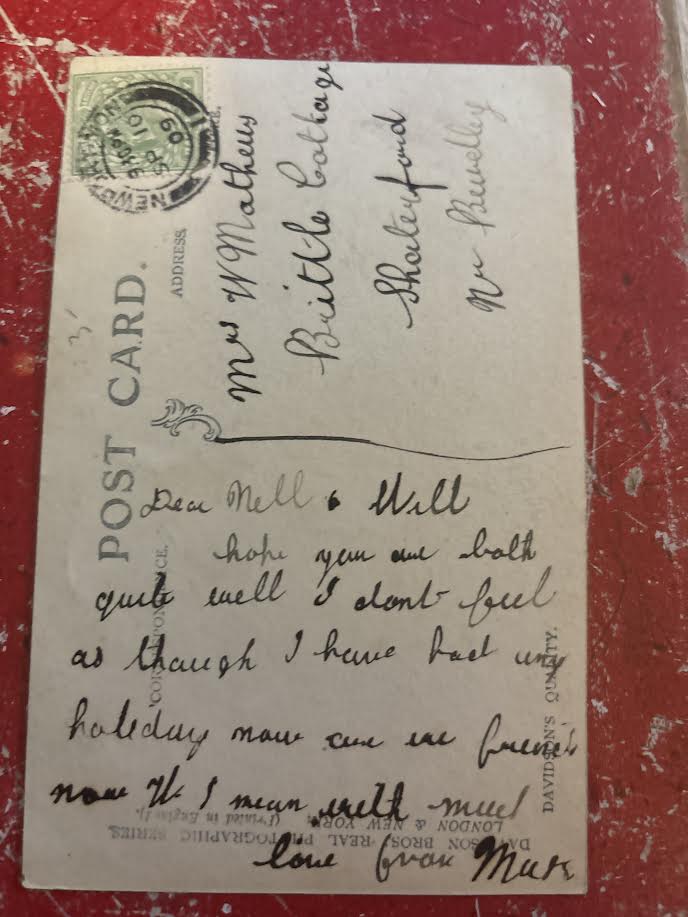
I looked up Constance Collier (1878-1955). Born in Windsor, England, Collier was "known to be very tall with a big personality." She was a dancer and actress of the stage. Later Collier migrated to Hollywood to become an acting coach. She collaborated with Ivor Novello to write plays and film. Novello starred in two silent films directed by Alfred Hitchcock: The Lodger and Downhill (both 1927). The Grove Dictionary of Music and Musicians writes of Novello he was until "the advent of Andrew Lloyd Webber, the 20 century's most consistently successful composer of British musicals." He was a trailblazer for other reasons. Hilda Hammerton postcards can be bought online.

My daughter found this postcard of Constance postcard (above) in a secondhand store in Osoyoos, British Columbia. There are a couple of lakes with nice beaches in Osoyoos, which is tourist destination in wine country on the US border. The store is a couple blocks away from the lake and owned by a man who migrated from Ontario a decade ago. We bought some cassettes from the eighties for 25 cents apiece (Whitney Houston, K-Mart Hits of the Year, etc.) for my daughter's Walkman II. I found some Beatles' fan papers as well. They cost $2.50 per. 

The postcard was sent from Newport, Wales to Brittle Cottage, Shatterford, misspelled as Shaterford, on September 10, 1909. How the postcard ended up in a little store in Western Canada for my daughter to buy July 20, 2024 is anyone's guess. Maybe Nell and Will immigrated to Ontario and were related to the proprietor. The postcard reads:

"Dear Nell and Will, [I] hope you are both quite well[.] I don't feel as though I have had any holiday now can suc friends name the I mean with much, love from Mark."


8/15/2024

What Have You Done for Country, Enderby, B.C., Canada?

We drove up into the Okanagan region from Vancouver this summer. The Okanagan, set east of Vancouver, is the warmest area of Canada. Cache Creek, Canada's only desert, sits on the northern fringe. There are wineries throughout, winding, steep roads with speed limits that dip down to 20 km/hr. leading up into the Rocky Mountains. When I was a kid, I used to go down to the Okanagan from Prince George to play sports. I was impressed by the heat even then. Now it is similar to California. Scorching hot. Zero humidity. 


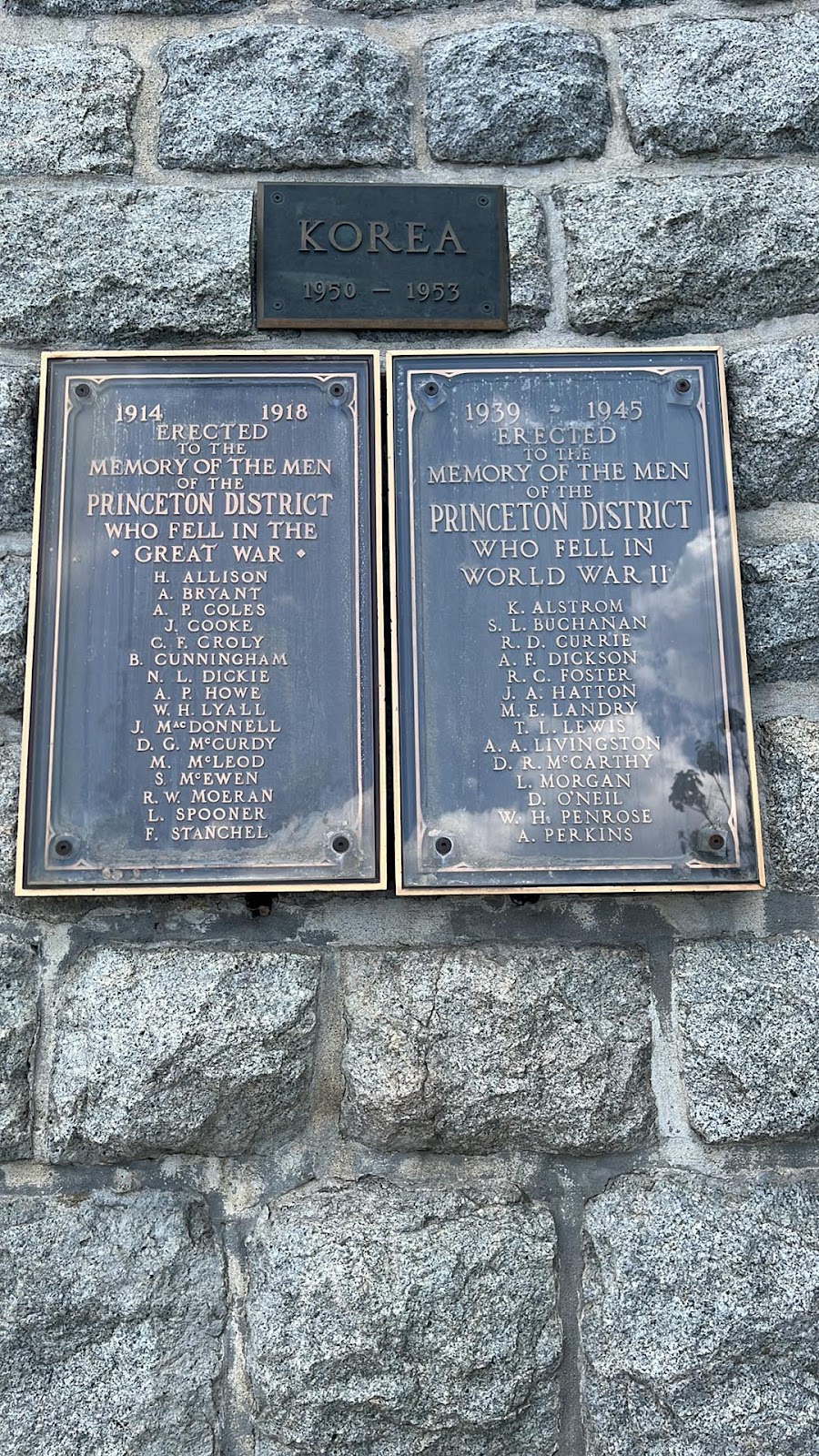
This is a record of men from Princeton, B.C. who died during WWII. This war took place in Europe, not Canada. Canada was a colony of Great Britain, so youngsters were dragged into war, half a world away. 


Enderby, B.C. The museums are so expensive in Canada now. I walk around the downtown Main Streets and hit the parks nearby to get a lesson. Who is going to pay $30 to go into a museum? 

The population of Enderby, B.C. is 2,947. The town runs between a ridge to the north and a river, for around twenty blocks. I bet Enderby was smaller eighty years ago. Fourteen guys died from Enderby in World War One. 


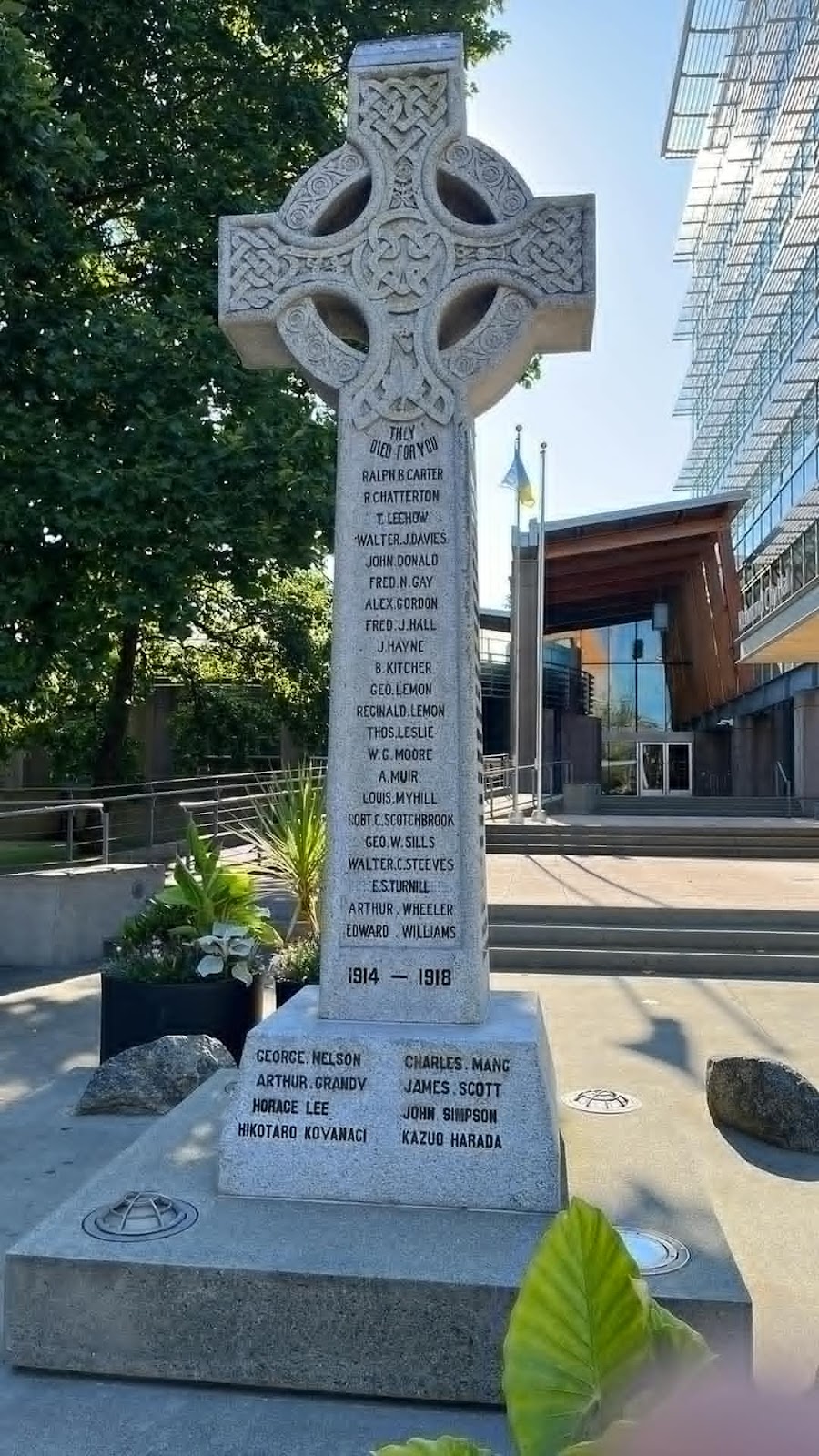
Here is the memorial for the men that fell in World War One from Richmond, B.C., Canada. Notice at the base of the memorial two people with Japanese surnames who died: Kazuo Harada and Hikotara Koyanagi. "They died for you," the memorial reminds us. This was a war that took place in Europe, not North America. I am not really sure why these two immigrants fought. To uphold inbred monarchs or stop Germany who was late to imperialism from achieving colonies of her own? They were not defending their homes or way life at all. In World War Two, 22,000 Canadians with Japanese last names, some undoubtedly related to Harada and Koyangi, would be interned in prisoner camps. Old people, kids, women. They were forced out of their homes. The businesses they had created and operated were smashed by mobs. Pretty much all they worked for was stolen from them and not compensated until 1988. In 1988, PM Mulroney signed a bill to compensate the survivors of the prisoner camps and Canadian mob rule $22,000 per.

Around 5,000 people of Ukrainian descent were interned in similar camps during World War One. This was another case of the Canadian government invoking the War Measures Act and detaining (not arresting as habeas corpus was not upheld) any one not looking right. 


7/18/2024

Hope Is in B.C.

First Blood, starring Sylvester Stallone, was filmed in Hope, B.C. We are coming up on the 40th anniversary. First Blood has grossed US$150 million on a budget of 15. Hope is small, a mountain town a couple hours north of Vancouver by car. 


This cinema opened up in Hope in 1945. First Blood (above) was showing when we were in town. There is a walking tour of Hope for the filming of First Blood that takes one around four or five blocks of the town, with 13 stops: 

1. Sheriff Teagle picks up John Rambo on Water Avenue, which runs along the Fraser River and serves as Hope's bypass. The Fraser River starts in Prince George, my hometown, around 1000 kilometers north. It empties out through Vancouver into the Pacific. The sheriff takes an immediate dislike to Rambo and his kind, although he has no idea about him because he has never met Rambo before. 
2. Rambo jumps tracks at Third Ave. 
3. Rambo speeds past the H tree on Hudson Bay St. An H tree has twin trunks.
4. Sheriff Teagle's police station was put up in front of District Hall. The actual police station in Hope is manned by the RCMP (Royal Canadian Mounted Police), so that wasn't going to work. The town is supposed to be in southern Washington state, not southern British Columbia.
5. Mountain State Savings was supposed to be at 10-300 Third Avenue. There is no such place in Canada that I am aware of. Fake bank.
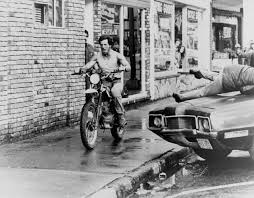
6. Realizing justice is something he cannot hope for, Rambo breaks out of jail and commandeers a motorbike. He speeds down the sidewalk of Wallace Street as pedestrians scramble to make way. Message to the town and especially its sheriff: I tried it your way and that did not work. Make a path. I'm coming through.


Rambo on the sidewalk in Hope.

7. The Outpost Gun Shop was made for the film. Rambo took it out.
8. Rambo walked under a "Welcome to Hope" sign at the start of the movie. Like lots of Canadian small towns of the eighties, he found out this one wasn't so welcoming. The sign is gone. I looked up the definition of hope. I found two noun classifications of hope and one verb: "A feeling of expectation and desire for a certain thing to happen." Or, "a feeling of trust." For verb, "want something to happen" or "to be the case." To be the case to me means wishful thinking, which is good explanation for any destination or place we would like to settle down in. 
9. A gas station was constructed the Crowsnest Highway for Rambo to blow up.
10. Sheriff Teagle drives John Rambo to the other side of town and tells him not to come back because they don't like his kind around here. Rambo, mystified by the inhospitable behavior of Teagle, decides to circle back to figure out what's what. Actually, nobody believes that. This has become a dick-swinging contest between a small town sheriff and Vietnam vet. If Rambo had taken the sheriff's advice, the movie wouldn't have  had anywhere to go. First Blood would have been over after fifteen minutes. And Rambo absolutely did not draw first blood. The sheriff drew first blood by harassing Rambo and calling him a hippie. True, Rambo was looking shaggy and unkempt, but nothing could be further from reality. 
11. Rambo speeds through a Chevron Station. It's the Hope Pizza Place now.
12. Rambo Lane. There's a Stallone's Bar in town as well. One can order a Rambo Burger for $Cdn.25 (two burgers, eggs, pickles, onions, vegetables and bacon). 
13. Rambo blows out a transformer. A FIELDS sign is behind him. FIELDS is an old school five and dime, like a small town version of Walmart selling cheap shit before we importing it from China. FIELDS is still in Hope.

The downtown of Hope is ten avenues by fifteen streets. I suppose many people would consider it dated. I don't want to pay for museums in Canada because they are so expensive. I find a museum version of history on the streets instead. 


7/10/2024

Queen Elizabeth Park

I took a few photographs at Queen Elizabeth Park in yesterday. I walked up to the park, which is at 29th and Cambie in Vancouver, with my wife and kid from the King Edward SkyTrain station. I worked near Queen Elizabeth Park in the nineties and used to go there for my lunch hour to read. Not much has changed. There is a food truck now at the top of Little Mountain. It sells those twirling fries (salt and vinegar, pepper, Sriracha) on a skewer, fried mac and cheese, wild cod tacos among other dishes. I see there is a disc golf course. Disc golfers have to throw a Frisbee instead of hitting a golf ball around a course of eighteen holes, like golf. Only the holes are baskets.  


 The clock, which needs a wind, was donated by the Lions' Mandarin Club, in 1991.


This was a quarry a century ago. The park is named after Queen Elizabeth's mother, Queen Elizabeth or the Queen Mom. She visited Vancouver as WWII was breaking out. 


My back is out again. I can't lift my arms easily. I was trying to get a shot of the West End from the park. Did not quite make it.


King George VI and Elizabeth (above center) visited Vancouver in 1939. Looking to shore up support among the colonials, they made their way into town from Banff via Kamloops. What fighting in Europe, half the Earth away, had to with Vancouverites is not clear. What was stirring in the Pacific would have probably more relevant.  

There is belief that George's older brother did not abdicate in 1936 because he wanted to marry a divorcee and foreigner. No precedent was set -- Prince Harry did the same a few years ago. He was a Nazi sympathizer and possible collaborator. The royals were in Canada for the England to get a better grip on Canadian sentiment obviously. 

************************

The Act Prohibiting Importation of slaves of 1807, 2 Stat. 426, brought to bear March, 2, 1807 became a US federal law prohibiting the importation of slaves to the country. The order, signed by Thomas Jefferson, third President of the US, took effect January 1, 1808. The short of this new law was anyone caught importing people to the US to be slaves would be arrested and subject to capital punishment. Here's the thing, every subsequent President up until the Civil War, including Jefferson. 

I just finished reading this book: 


I checked The Last Slave Ship: The True Story of How Clotilda Was Found, Her Descendants, and Extraordinary Reckoning out of the Richmond Library here in Richmond a couple of weeks ago. The Clotilda is the name of the last slaving ship ever to run slaves into the US. The Clotilda sneaked into Alabama, near Mobile, in 1860. Timothy Meaher, the owner, did it on a bet. Meaher made the bet while captaining a steamboat. He strutted after a dinner party and told all he had nothing but scorn for the government. Then he had the Coltilda burnt and sunk to hide the evidence.   

It seems every single President from 1808 until the end of the Civil War categorically pardoned captains convicted of importing captives from Africa -- except one. Abraham Lincoln came down on side of the ruling judge, W.D. Shipman, who proclaimed the following in sentencing of Nathaniel Gordon to Gordon, captain of the Erie:

"Do not attempt to hide [slaving's] enormity from yourself: "think of the cruelty and and wickedness of seizing nearly a thousand fellow beings, who never did you harm, and thrusting them beneath the decks of a small ship, beneath a burning sun, to die of disease and suffocation, or be transported to distant lands, and be consigned to distant lands, and be consigned, they and their posterity, to a fate far more cruel than death," Shipman stated.  

7/03/2024

We Went to See the Vancouver Whitecaps. We Tried that Is

I bought three tickets for the Vancouver Whitecaps v. St. Louis SC (MLS) for June 29, Saturday. When we arrived at B.C. Place Stadium, a dozen workers waved a warning sign at me. One cannot have a bag larger than five by eight. The dozen workers had signs to explain visually how big that is, five by eight. Five by eight is wallet size. My camera bag was deemed too large. My wife's backpack with our passports and documents was definitely too large. Here was the solution -- we could pay ten dollars to leave our passports and documents hanging on a rod outside of B.C. Place. I pointed out there was no notification on the tickets about this rule. "It is on the Vancouver Whitecaps' website" was the reply.  


My wife decided to go to a coffee shop. She opted out as she figured it was not worth it to leave our passports and documents dangling on a rod outside. Actually, I thought we would all leave, but she said she did not care, which was mostly true. She wanted my daughter and I to go. 

When we entered B.C. Place Stadium, I was asked about why there wasn't a third person. We had three tickets, you see. I told the woman checking the tickets the bs with the bags. She grimaced. Since then, I have received an email from the Vancouver Whitecaps asking me to confirm that it was a wonderful experience. This question was even asked: "Do you go to see the Vancouver Whitecaps as a way of family bonding?" Well, we were thinking about that, until the Vancouver Whitecaps broke up the plan. 

I went out at just before the game versus St. Louis SC started. My daughter wanted blue cotton candy. The sign gang was lingering inside the stadium now. They looked tired out. They looked like they did not give a crap about soccer. Ruining other people's day was the idea. They were on to that and it had invigorated them. 

6/05/2024

Anti-Americanism in Taiwan 1932


On May 16, 1932, H.A. Graves, acting British Consul to Britain, wrote in his report to his Excellency of how he saw Formosa's response to their new Governor General from Japan, Hiroshi Minami: "Their attitude to existing conditions seems to be one of apathy rather than one of enthusiasm or gratefulment." Graves describes the situation, in other words, being colonized: "[Minami's] speeches differed little from his predecessors on similar occasions [of policy making], except perhaps, in the greater stress he placed on the development of educational facilities in the island." Graves is setting up a theme for Taiwan. He will develop how from the Formosans have not been melted into regular Japanese folk. "Possibly the measures are precautionary in view of the racial sympathies which the Formosans may hold for their mainland cousins." He argues Formosans sympathized with China, especially after a serious of violent outbreaks in Shanghai between the Chinese and Japanese living there, which he calls the Shanghai Affair (plus that year). There were at least two, in 1925 and 1927, in which tensions resulted in mob violence and death. With the censorship, illiteracy blanketing the island, and lack of radios and no TV at that time, perhaps Graves is dramatic about a place at the other side of the world, devoid of countrymen and hardly relevant to Europe. I wonder if Graves is whiling away the dull day or drumming up business. 

There is more to roll the eyes at. In 1932, the US was less the obnoxious world power and imperialist many believe it is today. America had an isolationist policy. Here's Graves: "There was a reputation of anti-American feeling from February onward." Amongst which group? The Formosans? First, Graves has suggested the Formosans knew what was going on in China. Americans, especially Christian groups in America, backed and financially supported the ROC. Or, he could mean the Japanese resented American behavior in China. The American Christian's point was to help Sun Yat-sen, who successfully campaigned for aid in the West, solidify China and pave the way for Jesus. Why would the Americans care if Sun and those coming after were harassing foreigners or driving them out? Graves finishes: "the attitude [toward] our own government has been considered sympathetic, and, in regard to Shanghai, distinctly helpful. The Tainan Shimpo--a newspaper with a traditional anti-British bias--has not for some time given new politically distasteful to us." What news has The Tainan Shimpo given about the world's superpower or country proud of its imperial record? The sun never sets on the British Empire.

"The authorities were, at the beginning of [1932], perturbed at the spread of dangerous thoughts amongst Formosans and an increase in police activities was decided upon. Mr. Sonzo Tomobe, and officer with special aptitude for this work, was appointed to Chief of the Police Bureau and, quite recently, 36 special police have been added to the force." It seems the martial law installed by the KMT after the ROC's invasion of Taiwan and the White Terror it wrought almost twenty years later was not new to the Formosans . 


There are many words that do not really make sense in the report. There was no spell check then and the pages have faded. In long letters, the first word of next page is printed at the bottom of the previous page to help the letter assembler get the correct chronological order. 


2/20/2024

Tropic of Cancer Taiwan


The Provincial Highway 9 Ruishui Marker (above) marks the Tropic of Cancer, 23.5 degrees on the northern latitude, in Taiwan. The spot was developed in 1933 by the Japanese colonial government. This monument was finished 48 years later. It is on the side of hill. Trees and bush cover the area.


Provincial Highway 11 is Taiwan's easternmost highway. This is a newer marker. There are food and souvenir shops next to this 23.5 north and across the highway. Provincial Highway 11 is the fastest way to get from Hualien to Taitung driving.

2/05/2023

Capybara Taiwan

My family rented a car and we drove out to Greater Yilan two Mondays ago. We stayed at the Lakeshore Hotel Suao, a five-star hotel with adjoining hotspring and coldspring tubs in the room. 

I recommend getting a car for Yilan as public transportation in northeastern Taiwan is sparse. The drive is fine, excluding the last tunnel coming in (13.9 kilometers tong). By the end of the tunnel, I was tense. Driving through long tunnels hypnotizes me in the same way driving on a snowy night does. We stopped at at the Yilan Zhangmei Grandma's Farm before we left Yilan because my daughter wanted to check out capybaras. Capybaras are the world's largest rodent and come from South America. Bill Peet modeled the wumps of his classic 1970 children's book Wump World after the capybara. 


8/19/2022

Mandarin Airlines: The Flight Attendant Tricked Me


Western Fisher Island, Penghu / Pescadores (澎湖): The Western Fort on Fisher Island dates back to 1681. Built two years before the fall of the Koxinga Dynasty in Taiwan, the battery was meant to defend the country against Shilang, the admiral sent by the Emperor Kangxi to clear the island out of bandits. Kangxi originally meant to defeat Koxinga's . . .

This is as far as I got. I was flying back to Taipei from the Pescadores on Mandarin Airlines. The flight attendant told me to turn off my computer. When I indicated I was in flight mode, she came within an inch of clapping my computer closed. She said: "Using a computer on a domestic flight is against the law in Taiwan." When I asked her why, she showed me the safety card in the pouch of the seat in front of me. I called Information for Foreigners when we landed. They said they did not know about that law and gave me the number for the civil aviation authorites. There is no such law in Taiwan. 

...anyway, I am back a week later to writing this post: Koxinga's grandson, Zheng Keshuang. The Emperor Kangxi wanted to evacuate Taiwan after the Qing Dynasty military defeated Zheng's forces, to remove all the people in Taiwan who seemed Chinese. He said Taiwan was a piece of muddy shit floating in the ocean beyond China. Shilang explained it was necessary to maintain a presence in Taiwan to clamp down on pirates. There was an idea to entice the Dutch East India Co. back, but the Dutch had lost interest in Taiwan. Zheng was taken into tribute captivity and imprisoned in China a couple of years later (1683).

I think the Pescadores were also evacuated in 1425, after the lightning strike and subsequent burning of the temple in Nanjing (I forget the name), which resulted in all people being forced to move inland, away from the ocean. The Chinese Navy was also put in storage at that time. 


2/09/2022

A British Consul's Report: Formosa 1895, Respect the Queue

This report came out of Tainan instead of Tamsui from the British Consul, R.W. Hurst, late 1895. Hurst is commenting on the state of Taiwan eight months after China ceded Taiwan to Japan. He calls the ceding an invasion. Taiwan’s junior high school social study textbooks label the ceding of Taiwan by China to Japan in the same terms but, for a reason likely related to indoctrination, do not label the arrival of Chiang Kai-shek and his forces after WWII an invasion. Why the British Consul located to Tainan before 1895 has not been told to me. My guess is Britain cleared out of Tamsui when the French and Chinese became hostile there in the 1880s. Taiwan’s junior high school social study textbooks stress aboriginal groups favored Chinese settlers over other invaders, Japan here and the Dutch East India Company (labeled as Holland in those social study textbooks) before, but the Consul does not share the opinion (see his opening comment) and neither do I. Hurst later writes, “The inhabitants of Formosa, a specially timorous race, have under these circumstances have been slow gaining confidence….” Hurst seems antsy too. The first pages of the report on Taiwan follow:

H.M. Consulate, Tainan, 31 December, 1895

Separate Sir,

I have the honour to forward an Intelligence Report for Tainan for the Quarter ended this day. I have the to be, Sir, your obedient Servant, R.W. Hurst, Consul

Sir E.M. Safow, KCMG, Her Majesty’s Minister, Tokio

Enclosed in Consul Hursts’, Tainan, Sep of 31, Our 1895

Tainan Intelligence Report for the Quarter ended 31 December 1895

Political

The subjugation of the country by the Japanese except as regards the aborigines who are said to be favourably affected towards them may now be regarded as complete.

For the first 2 or 3 weeks after the occupation a veritable reign of terror prevailed among the panic stricken Chinese. In Tainanfu for many days all the shops closed their doors and it would have appeared like a city of the dead, were it not for the conquering army of Japanese, which was much in evidence parading the principal thorough-fares and occupying many houses which the timorous owners in their panic had deserted. Owing to the truculence of the coolies, the camp followers of the invading army, . . .

[MY NOTE: Taiwan was ceded to Japan by China in April of 1895. The Japanese were not invading.]

. . . a congress of the worst class in Japan, which frequently behaved with much brutality towards them, a large number of Chinese abandoned their dwellings, and fled into the interior, whilst others, including a large proportion of the well-to-do classes have sought a refuge on the mainland of China from the unpalatable rule of the alien.

[MY NOTE: These that fled later came to be known as Half-Mountain People. Many returned to Taiwan with Chiang Kai-shek in the 1940s, their fortunes reversed. They were broke. There is talk of their involvement in the drafting of kill sheets used for the 2-28 massacre of Taiwan’s ruling class.]

The dwellings of all unless they were able to produce title deeds were at the mercy of the conquerers, and much misery must have resulted from destitution and exposure. The inhabitants of  Formosa, a specially timorous race, have under these circumstances been slow in gaining confidence, which can hardly be considered fully restored.

Soldiers with fixed bayonets are still posted at Tainanfu.

[MY NOTE: I cannot read the next word. The cursive is pretty, but it looks like “coho.”]

. . . [The soldiers with bayonets] pounce down upon any unfortunate Chinese who may pass with his queue coiled round his head, a procedure resented as wanting in proper respect.

Hurst’s Consular Report continues for a few more pages. 

11/15/2021

I Want to Practice English

初訪,再也不會去!問老闆「你會講中文嗎?」然後老闆就開始發飆了!什麼東西啊?有事嗎?這是禁語嗎?我英文不好只會講中文先跟你確認一下是有冒犯到你?還是全世界都要知道你會講中文?自以為是什麼東西啊?老外很屌?


講完態度再來講環境,一進門油煙味重到爆炸,衛生也不ok環境也不怎麼舒適整體也很髒亂。

酒很多種類?不好意思我本身就喝精釀的我還真不知道你有什麼稀奇的東西,一櫃大識貨,不知道在跩什麼?我去過的酒吧餐酒館至少五百家,這家我直接給最後一名!沒有亮點又臭又囂張!

更新,目前最後一名被碳烤鐵人搶走

店家的回應還真是高姿態喔zzz

This review left for my restaurant is bullshit and libel, and racist crap. I do not normally respond to reviews, but I did for a change. I wrote: "This is racially motivated hate speech." I tagged the review above as offensive. Google actually removed it. I want to hold on to it for reasons of my own.

The writer starts his ramble by suggesting I asked him about his English ability -- if he could speak English. That is a lie. I never do that. In fact, I often tell Taiwanese people who insist on speaking English to me that I am French or something else, just to get out of answering the usual stuff or for efficiency. Then my interlocutor claims I shouted at him. Again, a lie. I was joking loudly with my friends at the end of the counter, on the other side of him. I spoke to him, and his group, once. I had one verbal engagement with them all night. He said he wanted to practice English with me. I said to him: "I already speak English fluently, so I do not need the practice. My wife Shufang and her friend Sally, she's sitting next to you, love to speak English." He rounds out his review by asking: "Are all honkies (foreigners) such dicks / assholes?"

I was busy cooking because that is what I do when customers come into my place. I cook. These four men sat down across from me and started to yammer: "Look. It's a foreigner. Hey boss! We want to practice English. Do you like stinky tofu? Etc." Why not rock out the practicing with the Taiwanese people in my place? Lots of Taiwanese people enjoy practicing English. A native speaker has no need to practice English. Or, if you really want to learn English, just sign up for a class in a school or take one online. Hire a private teacher. Travel. Get someone with qualifications, not a cook in a hole in the wall, to help.

These four men were after me from the get go. I was busy. It was Friday night. Why did they write that review (above)? I was not anything to them. I had never even met them. Would they conduct themselves like this at any other restaurant in the neighborhood? Would they harrass the owner of the chicken fry shop down the way to practice a school subject with them? There is a place a few doors down from The Hammer, a restaurant that makes traditional Taiwanese soup. It is sour, with sticky meat balls that are savory. The soup tastes great, especially with vinegar. Why not bug the owners of that place instead of me? Go perch up inside their restaurant and have a go at the boss. I have a feeling they would not harrass one other boss around here in this way.

The Hope of Salt Spring Island

Dock at Ganges, Salt Spring Island I came back to Vancouver last Thursday to, amongst other things, watch the World Cup of soccer. Vancouver...