5/21/2011

Mixing Up Taipei's History


This is how an individual, or group of individuals, obviously employed by the Taipei government, has chosen to sum up the history of Taipei concerning the Red House in Ximending (西門町). Unfortunately, the writer(s) of this account (above) is either politically motivated or foolish. I suppose I'm nonplused as well. I can't figure out if a.) he or she has no concept of historical recollection or b.) he or she is rewriting history following the misguided concept that we here in Taipei need an untrue sense of it. Either way, there's just more muck for us to wade through and sort out.  

Have a look at the first sentence in the description: "From its completion in 1908 to today, Red House has witnessed the Qing Dynasty, the Japanese occupation of Taiwan, and the Republic of China." First of all, the Qing Dynasty sold Taiwan up the river in 1895 when they surrendered Taiwan to Japan as part of the Treaty of Shimonoseki. In 1908, they were already 13 years gone. I'll restate this point: the Red House wasn't around in 1895, when the Qing vacated Taiwan. How could the Red House witness the Qing Dynasty if it wasn't built when the Qing left? Even if the Red House had obtained a telescope and pointed it across the strait, it would have been looking at the Qing for a couple of years as the Qing fell in 1911. You think Red House would have remembered such a brief episode? Or how about this one: when the author(s) states the Red House "witnessed the Qing Dynasty," do you think he or she is trying to tell the truth?
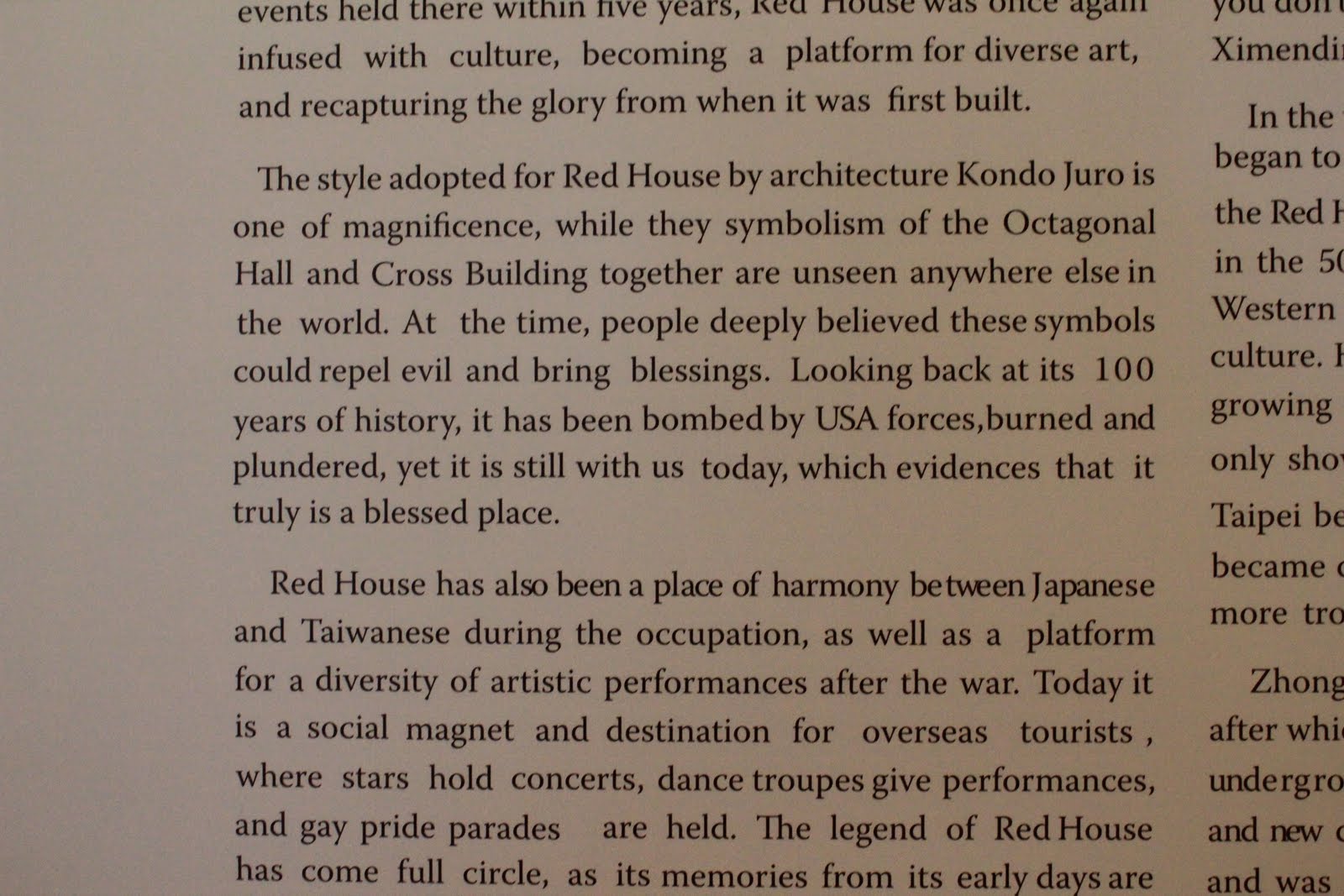

The author(s) later claims the Red House was "a place of harmony between Japanese and Taiwanese during the occupation, as well as" some other stuff. This is a misleading statement. First of all, Taiwan was never "occupied" by the Japanese. (This word comes up again and again though -- what's up with that?) It was "governed" by the Japanese after China ceded Taiwan to Japan in order to get out of the the Sino-Japanese War (1894-5). In fact, Taiwan was not occupied until 1945, when Japan surrendered to the U.S. and KMT troops came to our island. Since the KMT had no treaty or official / legal agreement of any kind to arrive here, this party was undertaking the occupation. As this detail is not touched upon anywhere within the exhibit; I am inclined to believe a bit of disingenuousness and other shenanigans are underway.

There's one more piece of nonsense to clean up here. According to the author(s) of the Red House account, the Red House was "bombed, burned and plundered" by the U.S. during WW II. It is true U.S. planes hit Taipei and Taiwan from October 1944 until the end of the war. In doing so, they managed to take out 75 percent of the country's infrastructure. My wife's great-aunt also died during one of the raids. But American soldiers neither burned nor plundered. As America did not have ground forces in Taiwan, this simply could not happen. With the exception of POWs, American soldiers never set foot in Taipei or anywhere else during the war.

I was only kidding before. I think I can figure out what's going on here. The Taipei government leans toward China, even if most of the population is not on their side. They hope people'll change though and want to do their part. By putting a Chinese stamp all over Taiwan's history, and doing a little rewriting here and there, perhaps this end will be met. 


Taipei's Red House

5/05/2011

Taipei's Crosswalks


Are the crosswalks of Taipei for pedestrians to cross the street when the light turns green and beckons to them to do so? Or are they purely decorative -- geometric patterns to break up the monotony of our city's abundant cement in its blue-gray?

I took this video tonight at the corner of Dunhua (敦化) and Civic Boulevard (市民大道) in Taipei. I cross the street every night on my way from the office to the MRT, so I'm pretty used to having to duck, dodge or flat-out stop to let cars pass. Here, a driver almost takes out a group of six or seven pedestrians, myself included, to make a right-hand turn. It seems the driver was in a hurry to make the red light going on 50 meters down the boulevard. He was also talking on the phone, but not so engrossed to miss me filming him on my iPhone. How do I know? Well, we made eye contact. Then he jumped up off his seat and almost swallowed his cell. 

To change things, I'm starting to believe, it's up to Taipei's citizens to be vigilant. Here's my contribution. By the way, I managed to catch his tag (license plate number). Watch out for G49950 if you're out for a stroll. He's reckless in how he wields his vehicle.

I've decided to start filming this intersection every evening I pass over it. I'll throw the clips up YouTube from now on.


4/30/2011

Department of Parks and Street Lights


People in Taipei do dry their items in parks from time to time: http://patrick-cowsill.blogspot.com/2009/03/multipurpose-playground.html.

I took this shot at a park near the Taiwan Presidential Office. It's near to a White Terror Memorial I hadn't noticed before: http://plixi.com/p/91440631. If you want to visit, go to google maps and input 台灣臺北中正區介壽公園.

White Terror was a period of martial law that lasted in Taiwan from 1949 to 1987; I think it may be the longest official era of martial law in the modern era. During this time, some 150,000 Taiwanese people were either imprisoned or murdered, or both, by the ruling KMT. Their government, which was not elected, described White Terror as an action necessary to suppress communism and root out traitors. Of course, many were (and are) skeptical, seeing it as simply a license to secure power. The back story was KMT arrived in Taiwan after being defeated militarily in China by Mao and his communist forces in the late forties. As the positions of power, meaning those held by bureaucrats, professors, doctors, politicians and what have you, were already occupied by Taiwanese individuals, martial law became a means to remove them. Once they were out, unemployed KMT followers found employment.

But I'm afraid I'm meandering off topic. I wanted to say drying your clothes and setting up your own living room in one of Taipei's parks are, according to the above sign, fineable offenses. A couple of weeks ago, we faced a similar issue on the grounds of my apartment complex in Wanhua (萬華), which are, as far as I can make out, also public grounds. 

In the middle of the night, somebody dumped two good-sized wooden couches outside the doors to my building. Where the security guards were during this time is of course a mystery, especially considering if you park your bike outside for 10 minutes, they're on the scene. Instead of apprehending the culprits and getting rid of the couches, the security company affixed this sign to one of them: Please do not leave your furniture here. Then someone got the bright idea to add them to our playground for extra seating. That the couches were not secured to the ground and would, after a few downpours, be serving up slivers of wood for kids mucking around on them obviously did not figure in the equation. In fact, it wasn't until I showed the above pic to our building superintendent that the clutter was removed. 

My only question now is this: did the cost for removing the furniture come out of our building fees or off the lazy bugger who was sleeping at his post's (or, at the very least, not doing his job) salary? I think I already know the answer. To tell the truth, I like our security guards. They're just a bunch of friendly old guys who wave at me every morning and ask questions about how my fatherhood is going. If it has to be that the residents of my building provide them with their pensions, they should provide meaningful service occasionally is all. 

4/20/2011

Sidewalk Parking in Taipei


The last time I checked, it was illegal to take your vehicle and park it like this, in a non-parking zone, on a sidewalk. In my opinion, this "citizen" is screwing the good folk of Taipei times two by parking on the sidewalk. First, these scooters won't be able to get out; they are seriously hemmed in. Second, no pedestrian can slide through the three centimeters his (her?) car has left from bumper to scooter taillight. This parking job forces every pedestrian that comes this way out into the street. I took this shot at around 6:45 p.m. So the street was, it goes without saying, bulging with evening traffic.

I showed some of my colleagues this shot today. A couple of them, in unison, said: "Whoa! That guy will get a fine! Or maybe he'll (she'll) be fast enough to avoid a fine." I don't think getting a fine is what this driver should be concerned about. He (She) should be concerned that he (she) is inconveniencing other people. Actually, enough of the gender neutral. I'm pretty sure it was a guy, because some lunkhead came out of a dry cleaner's and stared at me when I was taking the shot on my phone; he had a "What the f%$#? That's my car" vibe.

*****

On a different note, I think I'll do a Weekly Links:
1. http://gotmahmojo.livejournal.com/161864.html
2. This article is almost five years old. It's still worth a read. Warning: it's disturbing: http://dissidentvoice.org/Mar06/OBrien23.htm
3. The Writing Baron has a great piece on the bullying of out-groups in Taiwan: http://thewritingbaron.com/train-to-nowhere. 

4/09/2011

Woman Pretends to Sleep in Priority Seat on Taipei's MRT


I'll preface this comment by saying Taipei has one of the best public transit systems in the world. Besides having a state-of-the-art MRT, which is clean, efficient and expanding, there is an extensive public bus system reaching to all parts of the suburbs and tourist destinations in the outlying mountains beyond. Indeed, there's pretty much no reason to drive to work or school if you live in Taipei. It's a cheap trip too; for example, I pay NT$31 (around a buck U.S.) to catch a bus and then the MRT to work every morning. Unfortunately, there are still some mean souls, as you will witness in the above clip, who insist upon giving the system a black eye. Anyone who commutes in Taipei has seen this type of unfortunate episode more times than he or she cares to remember. Here's a rundown on what I witnessed this morning. I'll follow it up with a suggestion or two:

I got on the MRT in Taipei this morning at the Longshan Station stop. It was already pretty crowded as it was Saturday morning and people were out to enjoy the weekend. A woman with two small children followed me into the carriage and made their way up to the priority seats. Everyone on the MRT knows what these are as they're dark blue, as opposed to the light blue of the regular seats. Priority seats are set aside for the elderly, disabled, parents with small children (like the woman behind me) and impregnated. One of the priority seats was empty, so the mother plunked her older child into it. I'm guessing he was around four. The other seat was occupied by a woman of about 40 to 50 years of age. I believe she knew she should give the seat up for the mother and her other child (around a year to year and a half). I noticed she was looking at the small family and pondering her next move. Instead of doing the right thing and getting her lazy butt out of the seat, she opted for another course of action and promptly pretended she was asleep.

As the MRT rattled out of the station, the mother put her seat-less child down and wrapped his tiny fingers around a nearby pole so he wouldn't fall down. Needless to say, he wasn't standing in the most stable way. Seeing this wasn't going to work, the mother was forced to pick him up and try to balance him in her arms while holding on to the strap. She also had to keep an eye on the second son, who was wiggling around and plotting mischief. Meanwhile, the woman with the lazy butt occupying the number two priority seat blinked open a couple of times before continuing with her pretended sleep. Low in sympathy and high in selfishness, she would have played out the charade if I hadn't gone over and tapped her on the hand.

"You need to let that mother sit down," I informed her. "Why don't you have a look at what's going on?"

"Why?" she asked me. "Why?"

"Because you are occupying a priority seat," I explained. Then I pointed at a sign indicating it was a seat reserved for the elderly, disabled, parents with small children and impregnated. The 40 something-ish woman had no choice but to stand up; everyone was looking at us. This is where things took an odd and disingenuous turn. Lazy butt actually wanted to explain:

"I was sleeping," she said. 

Like I said before, Taipei has a great transit system. For the most part, the people here are rule followers. They usually line up. They don't litter that much. And they show patience when it's crowded. But there should be more compassion for people, such as the elderly, disabled, parents with small children and impregnated who are also trying to navigate the system. Really, I don't know why, but there remains a sect among us who are way too stingy with their seats. During the Monday to Friday commute, it seems many of this sect are well-dressed, like they're office workers. The way I see it is they're going to sit on their butts all day; what harm would there be in standing for 10 or 15 minutes to surrender their seats to someone in need, even when they are in a non-priority seat? They must have their reasons, no matter how lame and unfathomable they may be.

The next time you see this sort of thing, call them out (if you're not already doing so). Give them a gentle tap or shake, or toe-to-toe kick to "wake" them up and whittle them out of their ill-begotten nest. There's nothing like a small public shaming to bring them around. Chances are everyone around you will give you a supportive nod. Who knows? When you're old, busted up and / or plied with offspring, somebody will do you a good turn too. Or, if we're lucky, this problem will be rooted out and resolved long before that happens. Please get involved and do your part. 

4/07/2011

Patchy History

I received an email from Mark, who lives in the United States and is currently sorting through his father's World War II memorabilia. He's trying to piece together a time line.  Mark wrote: "My father is a Veteran of WW2. He served for the US Navy in the Pacific Fleet during the War. He has some patches that he got during his service. One patch is written in Chinese . . ."

 
"The other patch says 'WANT FREE' 'BACK TO TAIWAN OR DIE.'

 
Both have blue, white and red insignia with the Taiwan's flag's star in the middle. My father can't remember who or how he got them but he thinks he traded some of his insignia for them. I would appreciate any info or advice you could give me about the origin of these patches."


I don't think either of the patches date back to World War II. First of all, Taiwan wasn't called Taiwan at that time. It was Formosa. Second, the Formosan (Taiwanese) people served in the Japanese Imperial Army and Navy up until September of 1945. Formosa's (Taiwan's) flag was the Japanese Rising Sun. After World War II, Taiwan was occupied by the KMT / R.O.C. (Republic of China) soldiers. The white sun on the top patch comes from their flag. 

The first patch reads: "Fight the Soviet (Russian) Communists" and gives the soldier's ID number, 2906 (there might be a record for this man somewhere) across the bottom. By the way, soldier 2906 served in the Love Battalion. During World War II, the KMT's R.O.C. and the Soviet Union were allies. The Soviet Union didn't even declare war on Japan, hence Formosa (Taiwan), until August 9th, 1945. Three weeks later, Japanese officials were sitting down on the USS Missouri to sign the terms of Japan's unconditional surrender to the United States.

I've mentioned it before on this blog: From October 1945 to February 1947, thousands of Taiwanese men returning from WW II were recruited and redeployed to fight in China against the Chinese communists. The latter were supplied and financed, though probably not as much as they would have liked, by the Soviet Union. That's when the Soviets came to be viewed by the KMT as enemies (see upper patch once again). We should also keep in mind the redirected Taiwanese men were promised NT$2,000 a month. When they arrived in China, they were annoyed to discover they would be paid in the lower Chinese currency. Promised future government jobs, they later returned to Taiwan only to find the positions already filled by recent immigrants from China. Needless to say, the number of volunteers dried up after the 2/28 Massacre in Taiwan, as locals learned to distrust what they were being told. Then, in 1949, the communists defeated the KMT and drove their military out of China completely. The soldiers who had patches like the ones above retreated to Taiwan at this time. And Taiwanese soldiers no longer went to China.

I think, Mark, that your father came in contact with Taiwanese fighting in China during the late forties. You say he served on a submarine that refueled in Shanghai. That is where he probably got these patches. You also think his sub refueled in Kaohsiung, Taiwan. OK. But why would a Taiwanese soldier have a "back to Taiwan or die patch" in Taiwan? On second thought, this makes sense to me. Perhaps he didn't need the patches because he was already home, making them redundant.

I don't know anything about the trading of patches and insignias. I don't know on what level it took place, whether or not it was frowned upon and so forth. The possessions of POWs, on the other hand, were often stolen by their captors, but that's another story. 

There are a few things to look into still:
1. Any records about your dad's submarine. Do you know the name of the sub, Mark?
2. I'd be curious to know who 2906 was. Can we look him up in the records here in Taiwan? I wonder how we do that. 

4/06/2011

CKS Airport Gets Culture

CKS Airport Exhibit

I grabbed this shot in the CKS Airport in Taoyuan, Taiwan on the weekend. It's pretty new; I hadn't noticed it before. The exhibit does okay in referencing the 13 recognized aboriginal groups in Taiwan (although there is nothing on the other dozen or so still working to gain some sort of status). Let me run down the 13 on the books, according to the information given here: 

1. Truku tribe: "Distributed among Siulin, Wanrong and Zosi townships in the mountainous of Hualien County [and of course across the rest of Taiwan these days], the Truku have a population of 'about' 20,711." This number would depend upon how you see things. Aboriginal groups tend to be matriarchal. Taiwan's census, however, is based upon a patriarchal system, meaning offspring take the father's "racial" status / surname.  Therefore, groups such as the  Truku would probably see a child born of an aboriginal mother and Taiwanese father as Truku. The census would have it another way.

2. Bunan tribe: "Bunan music was particularly admired when 'when' it was presented to the world in 1953 at the International Society of Ethnomusicology by T. Kurosawa from Japan [you don't say!]. Bunan music has since become a treasure in the ethnomusicology circle." It wasn't a treasure before 1953, and it hasn't been a treasure among the non-ethnomusicology circle of Taiwanese people since then?

3. Puyuma tribe: The paragraph closes, mentioning a rahan for the first time: "The rahan, or priest, is in charge of all rituals to please the gods and goddesses with beautiful harmony and to judge the millet yields of the year." A priest who pleases the gods and goddesses? Tell that to a Catholic; I'm sure they would not view a priest in such terms.

4. Thao tribe: The last sentence mentions the ulalaluan for the first time: "The ulalaluan is the representation of the ancestral memorial tablet [whatever that is] in the Thao culture."

5. Ami tribe: The last sentence again mentions something out of the blue: "Today military training has been largely reduced, and only an athletic meet, sea fishing, and celebrations with singing and dancing survive." Are you talking about Ami' traditions? Do you actually have the gall to suggest only these parts of Ami culture survive?

6. Atayal tribe: "The Atayal males are great warriors [we'd better watch out then], and the women are 'skilful' weavers." If that means "skillful," good. The tourists are gonna love it.

7. Paiwan tribe

8. Tao (Yami) tribe: "[A]bout 2,712" of them.

9. Tsou tribe: "The Tsou with a population of 'about' [and not exactly] 6,149 live in high mountain areas . . . . Today, the Tsou hold the heaven ritual, the evil spirit driving ritual and benediction, and the puberty ritual together at a regular time every year [end of explanation]."

10.Sakzaya [no space between number and name] tribe: "Since 2001, the Sakizaya have been aggressively promoting a cultural restoration [before that, they didn't care] movement in order to recover their traditional rituals, singing, dancing, and dancing of the Sakizaya [you'd think they'd be more interested in stressing they have certain rights; but hey!, what's an aboriginal gonna do if he or she doesn't know which dance to dance?!].

11.Rukai [no space between number and name] tribe: "Chaste women can wear lilies."

12.Kevalan tribe: "'Priests' are all women. [A female priest? Fancy that.]" Population is about 911. 

13.Saisiyat tribe: Pretty condescending understanding here too, sprinkled with more of the same whimsical impossible to comprehend.


Comment: Somewhere, some charlatan academic or group of charlatan academics is making money to spew this junk. Chances are he, she or they is being paid with our tax dollars. I don't know what is more aggravating:

a.) He, she or they is making the people of our Taiwan look insensitive to the world as it comes and goes from the country's largest international airport. 
b.) He, she or they is an educator, and is also busy feeding this kind of stupidity to younger people.

If you take a look at the picture at the top of the post, you'll see it's a beach house. An ocean spreads out from the front door beyond a white, sandy beach, and there is a palm tree for shade. I counted three palm trees in the exhibit. I didn't see a single yew, cedar or pine tree, or any other tree that normally grows in northern Taiwan. 

To me, this image exactly speaks to a troubling kind of revisionism that is going on here in Taiwan. Simply said, aborigines only come from the south. So, they are like Hawaiians and are different from us. In this idea, the people of the north aren't required to think or feel about what is happening in this discussion because palm trees don't normally grow in Taipei or other locations north of the Tropic of Cancer. 

Of course, this is not true as aborigines come from all over Taiwan. They come from apartments in Taipei, houses in Ilan and dormitories in Hsinchu. Most of them do not live in beach houses. I don't know of any that dance and sing around palm trees.

The Hope of Salt Spring Island

Dock at Ganges, Salt Spring Island I came back to Vancouver last Thursday to, amongst other things, watch the World Cup of soccer. Vancouver...