3/20/2010

One Stop down the Line from Taoyuan

1896 Map of Taiwan

I found this old map of Taiwan from 1896. I was trying to figure out what Neili's (內壢) name used to be when it was an Aboriginal town, if it was one at all. No Neili on the map, but I did find something interesting. Taoyuan (桃園), at least from what I can figure, used to be called Tien Liek and not Toakhoham. Or, perhaps the map is mislabeled, because Toakhoham sounds a lot like Tokoham, the name I thought the Japanese gave to Taoyuan. You can find Monga (艋舺), where I live, just below Taipei. It's spelled as it is pronounced in the Aboriginal language it came from, Bangka. 

I do know that Neili was called Kanzi Jiao (崁子腳), Kama Kah in Taiwanese, during the Japanese colonial era. Mr. Su has some great old maps of Taiwan's train lines, including one from 1925, see http://www.citycat.hdud.idv.tw/map1925.htm and that's what Neili is called on the maps. Plus I double checked with him on Kanzi Jiao being the old name for Neili. The Japanese train map is a bit weird in that some of the names are reading left to right, like Taipei. Others, like Kanzi Jiao, are right to left. 

There's also an English map here, showing Neili as a stop on Taiwan's original train line, built during the Ching Dynasty from 1885 to 1891, http://www.citycat.hdud.idv.tw/maps/01chungli.jpg. I'm not sure if the information on the latter map is exact. The original plan was to build a railway running north to south, Keelung to Tainan. That got whittled down to Keelung to Hsinchu, which is what the map is suggesting. I think the Ching rulers might have thrown in the towel once the line got to Shijr (汐止), which is just north of Taipei. Either way, the bungling of the railway was another example of the mind-boggling incompetence of the Ching. The Japanese finished the line right down to Kaohsiung just a few years after taking over.
A Neili Recreation Center

I was supposed to serve as a judge for a school in Neili the company I work for sells magazines to just last Friday. The contest was cancelled, but I didn't find out until after I had arrived. This was only my second time to visit Neili, so I decided to walk around the downtown core. Actually, the downtown core was pretty slow. With all of the deserted parks overgrown with weeds and long grass, especially north of the train station where I took the above shot, it didn't feel like a downtown at all. Neili, in my opinion, is a bit obscure. One reason for this might be most of the trains don't stop here. Or maybe it's the other way around. Located between Taoyuan and Chungli, the town seemed to be mostly residential. The buildings were starting to look a little dated, like they were built in the seventies and eighties. 

Another thing I noticed about Neili was the wires running everywhere (see above pic) and I'm talking wires on big wooden phone poles. On one street of houses (not apartments), I was thinking I'd never rent or buy there just because the telephone and electricity lines block the view. I was pondering this coming back to Taipei. One just doesn't see wooden telephone poles or even a lot of wires anymore. My in-laws, who live in Wanhua (Monga) have wires on their building, but those ones are just encrusted into the building along the sooty pollution and oil grime that has wafted from kitchen windows the past 50 years. They've become part of the building.


Rooftop of the Neili Train Station

I took this on top of the Neili Train Station. It's a platform or park if you will. One's line of sight going out is blocked in all directions by buildings. The platform does overlook the railway, so it probably provides a pleasant and even exhilarating view of the trains pulling up or speeding by at night. What I enjoy is the sign. To get a sign like that, there must've been people driving on the roof at one time. And I estimated the walking time from the nearest parked scooters to the rooftop to be no more than 30 seconds. 

*****
On another note, I've been having trouble posting Flickr shots directly to my site. Is there any way to send more than one picture to the same post?


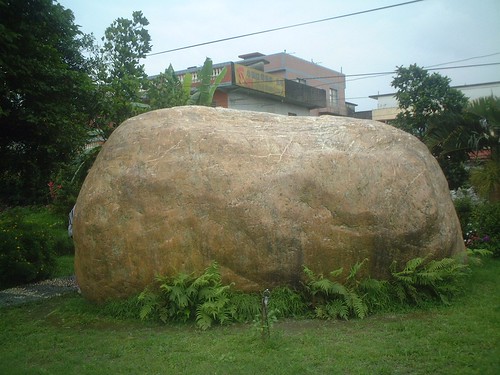
3/18/2010

Spirit in the Rock


Spirit in the Rock, originally uploaded by Patrick Cowsill.
This rock outside of Chiuliao Hsih (九寮溪), Taiwan was giving off strange energy. A fortune teller was called in and she determined 21 centimeter spirit was living inside. The spirit has blond hair.

3/13/2010

Hsu Chao-jung's (許昭榮) Lost Soldiers

I came across this article about writer and activist Hsu Chao-jung (許昭榮) in a past Liberty Times newspaper: http://www.libertytimes.com.tw/2008/new/may/21/today-so3.htm. The story covers Hsu's frustration with the Taiwanese government, which, to the best of my knowledge, pays pensions to KMT veterans of WWII but not Taiwanese veterans of the same war. It also discusses Hsu's suicide in 2008 in protest to the Taiwanese government's neglect of Taiwanese veterans. Hsu's suicide note, found in his apartment after Hsu set himself on fire in his car, stresses this point. 

I remember reading Hsu's book 動盪時代的無奈 台籍老兵血淚故事 when I was doing my thesis. I don't know what the English title would be; as far as I know, it has never been translated to English. Hsu wrote 動盪時代的無奈 台籍老兵血淚故事 in Japanese because he wanted to inform Japanese people of the behavior of the KMT invaders they left Taiwan to following the Second World War. It has since been translated to Chinese.

動盪時代的無奈 台籍老兵血淚故事 tells the story of the Taiwanese soldiers who served in the Japanese Imperial Army (200,000 Taiwanese served and 30,000 died) after they returned to Taiwan in the late 1940s. As Hsu explains, vast numbers of returning volunteers and conscripts would be turned around and promptly marched back out to the Chinese front to fight Mao's communists, sometimes at gunpoint. 

From October 1945 to February 1947, thousands of Taiwanese men were recruited and redeployed to fight in China. They were guaranteed NT$2,000 a month. Once they arrived in China, they found to their chagrin they would be paid in the lower Chinese currency. Promised future government jobs, they later returned to Taiwan only to find the positions already filled by recent immigrants from China. Needless to say, the number of volunteers dried up after the 2/28 Massacre, as locals learned to distrust what they were being told. 

One account given by Hsu Chao-jung that I find particularly touching is that of of marine Luo Tung-hui (羅登輝). Born in 1920 in Taichung, Luo was shipped out to Hainan in late 1943 when his wife was eight months pregnant. In September 1945, after the Japanese had surrendered to the United States, a boat arrived in Hainan to carry Luo and 39 other marines home. When a typhoon put the boat out of service, another was promised, but for after the lunar New Year. 

In the meanwhile, Taiwan was ceded to China and orders came down the Hainan contingent was to stay put. The new government, at war with the communists for control of China, wanted troops in place to defend the island. Five years later, Hainan fell and Luo, still deployed, was packed off to China for reeducation. In 1960, Luo was sentenced once again for counter-revolutionary behavior, this time for ten years plus an additional two for re-education, his second stint since being relocated to China. 

Luo never would make it home, although he came close. In 1989, no longer considered a Taiwanese national, he was denied a visa for entry at the Taiwan Consulate in Hong Kong on the basis of age. Veterans wishing to return needed to be 75 years of age. Luo was only 69. Luo passed away in Jiangsu (江蘇) in the early 1990s, bitter over hypocritical visa policies for veterans. Taiwan had a 75 year rule only for Taiwanese vets stranded in China wishing to return. Chinese vets in Taiwan however faced no such constraint. They could return home immediately.

Whether or not Luo Teng-hui (羅登輝) ever saw his wife or child in the interim remains unclear. There are a lot of other accounts in 動盪時代的無奈 台籍老兵血淚故事. I'll have another look and put a few more up.


我不喜歡沒有辦法的餐館, See Outback, Taiwan

I eat at the Outback Steakhouse, Taipei Asia World, on the corner of Dunhua and Nanking in Taipei, three or four times a month. I normally order a lunch set. Sometimes, I change the offered beverage (which is coffee, tea or a cola) for a beer. I pay a little more money for that, but figure it's worth it, especially on a long and tiring Friday. In the past, the waiter or waitress has said I could proceed in such a manner. I say: "Give me a cold Foster's draft to get me home" and they bring it round, adding NT$40 to my bill. Today, when I ordered Outback's fish and chips set, I asked the waitress if I could get a beer instead of a soda, and pay the difference.

To my surprise, my waitress told me "It's impossible" or "I won't help you." Actually, she was speaking Chinese and she said: 沒有辦法. This means what I have just said. Then she made an excuse that Outback Taiwan has a new menu, so it's strictly 沒有辦法 on requests for service.

I don't agree that if you're a waiter or waitress, you should say 沒有辦法 because, frankly speaking, it's very bad service. So, I simply got up and said to the waitress: 我不喜歡沒有辦法的餐館 or "I don't like restaurants that affirm providing a normal dose of service is quite impossible." Then I went next door and ate lunch at IKEA. I ordered roast beef and mashed potatoes, with mushroom gravy. I also had a bottle of Swedish beer.

I have decided to start outing companies providing 沒有辦法 service. Here's my first out. 

3/11/2010

Yanshui (鹽水), Taiwan Ready for Blast Off


A couple of pics on the Yanshui Fireworks Festival or Beehive Rockets Festival, beehive because the rockets are like bees for Taiwan. I wrote about them here: http://www.culture.tw/index.php?option=com_content&task=view&id=1678&Itemid=156

I can't separate the pics; Blogspot prefers them plastered together.

3/09/2010

Chinese Air Raid on Taiwan, Early WWII

My friend eyedoc put up an interesting post at http://danshuihistory.blogspot.com/2010/01/air-raid-feb-23-1938.html on the early days of World War II in response to my comments. I had written the following:

Jarmon, Robert. Taiwan: Political and Economic Reports - 1861-1960, Volume 7: 1924-1941, page 512: In January, 1938 "monster celebrations were organized to [celebrate] the fall of Nanking, in which all classes loyally participated" [British consul at Danshui describing the Taiwanese response to WWII - the celebrations took place in Taiwan]. On p. 510, I think, the consul described how either 500 or 1,000 (the book is not in my hand) Taiwanese volunteers were in Nanking as farming recruits.

Important dates:
1. September 12, 1937 (five days after the Marco Polo Bridge Incident) the first steamer of Japanese recruits from Taiwan leaves for China via Keelung.
2. September 28, 1937, British consul Archer makes the following admission: "Formosans are not yet liable to military service, but a number have been called up to serve in labor corps, and have been sent away to the front (Jarmon, 533). Archer stresses the impetus for volunteering was financial. In addition to rations, recruits received 1.20 yen a day.
3. Late December, 1937, a Tainan-based regiment of Taiwanese recruits returns from China through Kaohsiung (Jarmon, p. 563)
4. Consul Archer reckons by the end of September 1937, 1,000 Taiwanese are in China, though their service has caused "some disquiet among the Formosans" (Jarmon, 533).
5. April 26th, 1938, 1000 Taiwanese farmers comprising the Patriotic Agricultural Corps" sent to Shanghai. Number of volunteers greatly outnumbers the final total taken (Jarmon, 599).

Around the same time as the "monster celebrations", 200 prominent Taiwanese businessmen gathered to pass a resolution supporting the provisional Japanese government in northern China. Interestingly, on February 23, 1938, Chinese bombers appeared in Taiwan's skies, nailing both the Taipei Airport and Shinchiku Oil Fields without fielding as much as a scratch. Damage to the country's infrastructure was minimal. Damage to Japan's prestige among the local population was great.

Today I received an email from a friend in the US about this: 

"A little late but I do have comment on the article, “Air Raid Feb. 23, 1938” listed by EyeDoc on “The Battle of Fisherman’s Wharf.” First of all, I have discovered that the correct date is Feb. 22 instead of 23; see the two articles below. Both articles pointed out that Tai-Hoku, Taipei airport 台北市松山軍用機場 was attacked but Chin-Chiku airport 新竹飛行場 was not; instead the raid was on the oil field near Shin-Chiku, 竹東員崠子油井. The first article written in Japanese is by my Pen pal, Dr. Hwang who keeps diary for life that I have full trust on his record; see file attached. The second article looks and feels real McCoy; you may verify by yourself."


I'll put up a translation later, when I have time. I'm off to see eyedoc, who returns to the States tomorrow, now. More to come.

2/28/2010

Business is Hopping in Monga (艋舺)

I posted a couple of months ago about the controversy created by the film Monga, in particular, the local government's financial contribution to it and some politician's objections to how it portrays the crime-infested borough which is Wanhua (萬華) AKA Monga: http://patrick-cowsill.blogspot.com/2009/12/monga-film.html

The Taipei Times had an article on it a ways back: "Although Taiwanese movie Monga (艋舺), sponsored by Taipei City’s Department of Cultural Affairs, will not be in theaters until next year, content from trailers for the movie has already raised controversy...."

"Qingshan Borough (青山里) chief Lee Chao-cheng (李昭成) criticized the movie, saying organized crime was only a small part of Bangka’s history. 'It took us many years of hard work to get rid of the bad impression that people used to have of the area, but now [the movie] is restoring that image.''' 

Lee also said "All residents — young and old alike — are opposed to it" (Taipei Times, Dec. 1, '09).

Talk about grandstanding. This guy Lee hadn't even seen the movie as his comments came months before its release. As it is, Qingshui Temple (清水巖) and Bo Pi Liao (剝皮寮) Street, almost completely dead a month ago, are now wall-to-wall with visitors who want to see the area in which Monga (艋舺) was filmed. The exact part of Monga, as I reported in past posts, was revitalised just for the shoot. The streets look great. There are a couple of new museums. 

 
Bo Pi Liao (剝皮寮) Street


Anyway, I don't think all residents "young and old alike," are opposed to Monga. Surely, the people who own the shops and restaurants, plus the street vendors - people who were standing around with nothing to do a couple of months ago - are not cursing the local government's investment. Finally, myself, also a Monga (艋舺) resident, is not opposed to it. I say money well spent.

Note: Today is 2/28 Day, a holiday in Taiwan. Starting on this day, 53 years ago, KMT invaders from China went on a murdering spree here. Is it me, or is it being brushed over in recent years? My friend Grace's father was taken away by the police at this time, in his underwear. She never saw him again.

The Hope of Salt Spring Island

Dock at Ganges, Salt Spring Island I came back to Vancouver last Thursday to, amongst other things, watch the World Cup of soccer. Vancouver...